

Quarterly Fund Updates: The Hidden Operational Risk And Cost – And How To Fix It
Everything a fund manager needs to know about QFU automation
Accurate and timely performance reporting is fundamental to investor trust, regulatory compliance and a fund manager’s reputation.
Yet many fund managers still rely on manual processes and spreadsheets to calculate performance and produce investor reporting such as Quarterly Fund Update reports and monthly fund factsheets.
These fragmented processes and manual data handling introduce significant operational risk, key-person dependency and inefficiencies.
This article examines the hidden complexity behind investor reporting and how automation can transform a fragmented process into a governed, resilient, and scalable reporting framework.
What Are Quarterly Fund Updates?
Under New Zealand’s Financial Markets Conduct (FMC) regulations, all managed investment schemes — including KiwiSaver funds — are required to produce Quarterly Fund Updates (QFUs). These are mandatory disclosure documents published to the MBIE Disclose Register and made available to investors and the wider market, enabling comparisons of different funds across performance, time spans, risk indicators, fees and asset types.
QFUs bring together a wide range of information including:
- Fund identification (fund name, scheme name, reporting period)
- Fund description (investment objective, strategy, total fund value, inception date)
- Fund performance over time (returns after fees and tax, before tax, benchmark comparisons, since-inception performance and historical performance graph)
- Risk indicator ratings (1-7 scale, explanation of the risk indicator, links to more information on risks)
- Investment mix (asset allocations, target asset allocation, permitted ranges)
- Top holdings (investment name, country, asset type, percentage of fund assets)
- Fees and charges (total fund charges, management fees, administration and other charges, performance fees, examples showing the impact of fees on an investor)
- Key personnel (details of individuals primarily responsible for managing the fund)
- Currency hedging
- Further disclosures and links to investor information (PDS, SIPO, Disclose Register, contact information)
QFUs are publicly accessible through the Disclose Register, meaning they serve a dual purpose: satisfying a regulatory obligation while also acting as a visible signal of the professionalism and transparency of a fund management business. Investors and their advisers use them when comparing funds and making allocation decisions.
The reporting process includes a submission to Disclose Register – information that feeds directly into self-service investor tools enabling investors to compare funds using a number of criteria.
Getting QFUs right - accurate, on-brand, timely, and well-governed - therefore matters for both compliance and reputation.
.png?width=661&height=458&name=Clarity%20Funds%20QFU%20(3).png)
The Reality Behind the Report
A finished QFU report might be a couple of pages long. The process that produces it, however, is rarely that simple.
This complexity is one reason QFU production often becomes operationally challenging. The information must be:
- Gathered and consolidated often involving multiple sources.
- Reconciled and validated.
- Presented following prescribed criteria.
- Delivered as a designed PDF document.
- Data submitted in structured form to the Disclose Register.
- Published on the fund manager's website.
For many fund managers, QFU production looks something like this each quarter:
| Data arrives from multiple providers including custodians, fund administrators, performance systems, and market data vendors, as well as internal sources. Teams then manually validate and reconcile numbers, update templates and charts, coordinate reviews and sign-offs across investment, compliance, marketing, and legal teams, generate PDFs and CSV files, upload outputs to the firm’s website, and submit disclosures to the Disclose Register. |
These manual processes rely on highly capable key individuals operating within systems that have often grown organically over time.
But the result is a reporting process that is labour-intensive, time-pressured, and operationally exposed in ways that aren’t always visible until something goes wrong or the key person leaves the organisation or is unavailable during the critical reporting timeline.
Where is Operational Risk at its Highest?
The manual QFU process creates risk in several distinct areas:
Data accuracy. When data moves through multiple spreadsheets and manual steps, the opportunity for errors - transposition mistakes, formula errors, stale data, missed updates - grows with each hand-off. For KiwiSaver and managed fund products, incorrect performance figures or asset allocation disclosures are not just embarrassing; they can constitute a compliance breach.
Key-person dependency. In many firms, the QFU process is understood by one or two people who have built and maintained it over time. The institutional knowledge of where the data comes from, how calculations are made, and what the spreadsheets actually do often lives with specific individuals. When those people are unavailable — or leave — the process becomes fragile.
Governance and audit trails. Managing approvals, version control, and data lineage across email chains, shared drives, and disconnected spreadsheets makes it difficult to demonstrate clear governance to compliance teams or auditors. When was a number approved? By whom? What version of a file was submitted? These questions should have clear answers.
Scalability. Each additional fund in a product range adds proportional complexity to a manual process. As product ranges grow, manual reporting processes become increasingly difficult to manage and scale consistently across multiple funds and schemes. Reporting requirements also change as the fund passes certain criteria relating to time since inception.
Timeliness. Manual processes take time. For competitive fund managers, getting accurate performance data in front of investors and their advisers quickly matters. Being consistently last in the market with updates is noticed.
The Disclose Register – New API
An important development for the NZ industry is the release of the new modern REST-based API by the Companies Office Disclose Register which went live in March 2026. This supports faster submissions, reduced manual handling, improved data validation, and better interoperability between investment management systems and the register.
This is a significant opportunity for the industry. However, API-enabled reporting places greater emphasis on structured, governed and validated data. Firms relying on spreadsheet-centric workflows will find it difficult to take advantage of these improvements, or to meet growing regulatory expectations around data quality and submission standards.
For investment managers planning ahead, now is the right time to assess whether the current QFU operating model is built to support where the industry is heading.
Over time, the new API is also likely to open up opportunities to compare fund data, performance, fees and benchmarks more easily across different funds and providers – which will further increase transparency in a highly competitive market.
How can Quarterly Fund Updates be Automated?
AlphaCert automates the end-to-end QFU production process for fund managers.
Our platform creates a centralised, validated source of investment data that powers downstream reporting. It also provides powerful look-through capability to underlying holdings and handles complex performance calculations.
AlphaCert helps fund managers move from manual reporting to a governed, scalable operating model.
.png?width=916&height=512&name=ISG%20(1).png)
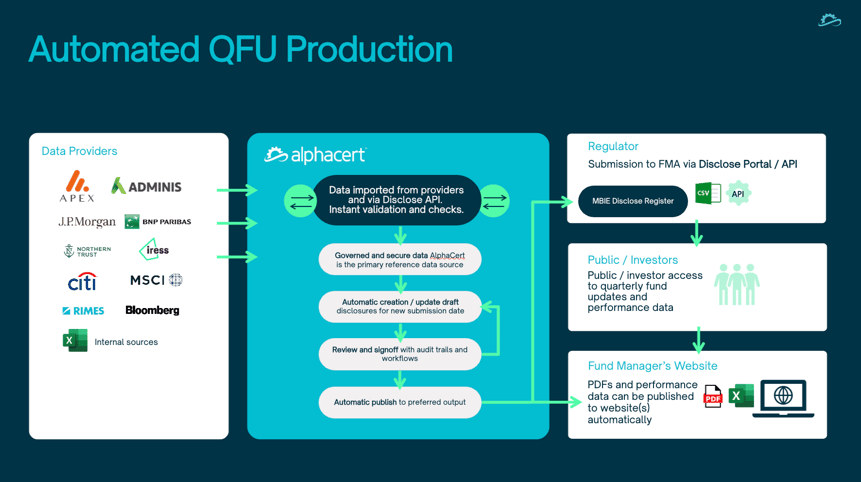
What does the end-to-end automation of QFUs and files for Disclose Register look like?
Data ingestion and validation. Data is automatically ingested from custodians, fund administrators, market data providers, and internal systems. Reconciliation checks and validation rules run automatically - with exceptions flagged early for investigation rather than discovered at deadline under pressure.
A governed, trusted data source. AlphaCert acts as a single source of truth for the investment data that underpins QFU reporting. Data is governed, auditable, and consistent — eliminating the inconsistencies that emerge when multiple teams work from different spreadsheet versions.
Automated draft creation. When a new reporting period opens, draft QFU disclosures are automatically created and populated with validated data. Teams start each cycle with a structured, data-complete starting point ready for review.
Workflows with audit trails. Review and sign-off workflows are built into the platform, with full audit trails capturing approvals, adjustments, and version history. Compliance teams have clear visibility of the process, and every submission is fully traceable.
Branded PDF generation. QFU PDF documents are automatically generated from validated data, customised to each manager’s brand guidelines, templates, colours, and layout requirements. The result is pixel-perfect, consistently branded reporting - without requiring manual design intervention each quarter.
Automated submission and publishing. CSV files for Disclose Register submission are generated and submitted automatically. PDFs and performance data can also be automatically published to the fund manager’s own website, removing the manual upload process and the key-person dependencies that often sit around it.
What is Investment Data Management?
Investment data management is the process of collecting, validating, enriching, governing and distributing investment data across reporting, compliance, analytics and operational workflows. It is the foundation of successful reporting and enables organisations to automate and scale processes using trusted data.
By maintaining a centralised platform to automate and manage investment data and standardising information from external providers and internal sources, fund managers can establish a single source of truth for investment data. This powers reporting, downstream systems and other processes while improving data quality, governance and audit-ability.
Strong investment data management also creates the foundation for AI readiness, helping ensure that analytics, automation and AI-driven insights are built on trusted, validated data.
What This Means in Practice
The benefits of automating QFU production are felt across multiple parts of the business.
Operations and investment teams spend less time on manual reporting tasks and more time on higher-value activities. Reporting cycles become faster, and the stress of last-minute validation under tight deadlines is significantly reduced.
Compliance and governance teams gain full transparency across the reporting process — clear audit trails, governed workflows, and confidence that regulatory obligations are being met accurately and on time.
Marketing and distribution teams receive consistently branded, professionally produced documents that are published on time, supporting the firm’s reputation with advisers and end investors.
Senior management have confidence that a critical operational process is running on a resilient, scalable platform rather than depending on the availability of specific individuals or the integrity of complex inherited spreadsheets.
And for investors - the people this reporting ultimately serves - QFUs and Monthly Fund Factsheets that arrive accurately, on time, and in a professional format, build trust and reinforce confidence in the fund manager’s competence.
Who Should Understand and Review their QFU Process?
- Executive team members of Fund managers and KiwiSaver providers
- Chief Operational Officer and Investment Operations and Data Analytics Teams
- Chief Risk Officer & Compliance teams
- Chief Investment Officer
- Investor Experience, Client and Distribution Officers
Beyond QFUs: A Scalable Reporting Framework - Fund Factsheets
For many fund managers, the same operational challenges that affect QFUs also exist across monthly fund factsheets and broader investor reporting. The same reporting framework can support a broader range of investor reporting requirements.
In addition to information covered by the QFUs, monthly fund factsheets typically also provide a market and investment commentary, and more detailed data relating to the fund.
Rather than building separate, disconnected processes for each reporting obligation, investment managers can work from a single governed data platform that powers all of their investor and regulatory reporting - consistently, accurately, and at scale.
As firms grow their product range, the platform scales with them. New funds are onboarded into the same framework, and reporting obligations grow in a controlled, managed way rather than compounding the fragility of manual processes.
The AlphaCert platform also delivers on-demand analytics and reporting on:
- Performance with built-in performance calculations
- Holdings and exposure reporting including look-throughs to underlying instruments
- Reporting across listed and unlisted assets
- Broader regulatory and compliance reporting
AI and Reporting
With trusted, validated investment data in place, firms are also better positioned to leverage AI. AlphaCert works with clients to develop AI-powered workflows and agents for analytics, internal reporting, monitoring, scenario modelling and operational automation. The quality of AI outcomes depends heavily on the quality of the underlying data, making strong data foundations a critical first step.
Getting Started
AlphaCert’s QFU and Disclose Register module is already used by fund managers in New Zealand, including clients managing billions in FUM across complex listed and unlisted product ranges. Onboarding is designed to deliver visible value quickly - typically weeks, not months - with AlphaCert’s specialist team providing the setup and investment operations expertise to make the transition straightforward.
AlphaCert’s delivery team manages the project including resources for technical setup, integrations and implementation, ensuring business requirements are understood and delivered effectively. This ensures minimal impact on BAU activities and no need for technical resources on the client’s side.
For fund managers that have lived with a manual QFU process for years, it can be hard to imagine the process working differently.
But the question worth asking is a simple one:
If you were designing your QFU process from scratch today, would you build it around spreadsheets?
If the answer is no — it’s worth a conversation.
Frequently Asked Questions
What is a Quarterly Fund Update (QFU)?
A Quarterly Fund Update (QFU) is a mandatory disclosure document required under New Zealand's Financial Markets Conduct regulations. It provides investors with information about a fund's performance, risk profile, fees, asset allocation and key holdings, helping them compare investment options.
Who is required to produce QFUs?
Managers of managed investment schemes, including KiwiSaver providers, are required to produce Quarterly Fund Updates and submit the relevant information to the Disclose Register.
What are the biggest risks in manual QFU production?
Manual QFU processes can create data accuracy issues, key-person dependency, governance challenges, limited auditability and scalability constraints. These risks often increase as product ranges and reporting obligations grow.
Can Quarterly Fund Updates be automated?
Yes. Modern investment data management platforms can automate data ingestion, validation, workflow approvals, PDF generation, Disclose Register submissions and website publishing, significantly reducing manual effort and operational risk.
What is investment data management?
Investment data management is the process of collecting, validating, governing and distributing investment data across reporting, compliance, analytics and operational workflows. It creates a trusted single source of truth that supports accurate reporting and operational efficiency.
How does the new Disclose Register API change reporting requirements?
The new API enables faster and more automated submissions to the Disclose Register. However, it also increases the importance of structured, governed and validated data, making spreadsheet-based processes more difficult to maintain over time.
Can the same reporting framework support monthly fund factsheets and other reporting?
Yes. The same validated investment data can be used to support monthly fund factsheets, performance reporting, holdings and exposure reporting, and other investor communications or regulatory reporting. The AlphaCert system is highly configurable and can be tailored to bespoke requirements.